
TADB 162: Repentance—Antidote to Syncretism

When One Word Changed Everything

Martin Luther was deep in translation work when something stopped him cold. He was comparing the Latin Vulgate with the Greek New Testament, working through Matthew 4:17, when he noticed a problem. The Latin text had Jesus saying, “Do penance, for the kingdom of heaven is at hand.” But the Greek word behind “do penance” was metanoia — and metanoia doesn’t mean penance. It means a change of mind. A fundamental reorientation. An about-face.

That single word had been quietly doing enormous damage.

The Church had built an elaborate system around the Latin word penance (paenitere) — sorrow, confession, assigned prayers, fasting, and financial contributions — as though sin were a debt to be managed and repaid.  But Jesus wasn’t calling people to manage their sin. He was calling them to wake up. Something new had arrived — the kingdom of God — and the only appropriate response was to reorient your entire life around it.  That’s why His common invitation was “follow Me.”

That discovery didn’t just light a fire in Luther. It ignited the Reformation.

Repentance Is Not a Transaction

Luther didn’t initially reject repentance—he deepened it. Luther’s first thesis in 1517 made his position clear: the entire life of believers should be one of repentance. Not a one-time religious step. Not a payment plan for sin. A lifelong transfer of allegiance from one kingdom to another.

That’s worth thinking about for a moment. In the military sense, metanoia is an about-face. You were moving in one direction — under one commander — and now you have turned 180 degrees to place yourself under another. Repentance isn’t admitting you were headed the wrong way. It’s actually turning around.

Regret and remorse can accompany repentance, but they are not its essence. Paul makes this clear in 2 Corinthians 7:10 — godly sorrow is the fruit of genuine metanoia, not its root. You can feel terrible about sin and never actually turn from it. You can confess with your mouth and never transfer your allegiance. That gap is where syncretism quietly survives.

Scholars on Metanoia

Modern evangelical theologians consistently describe repentance as far more than regret. J.I. Packer emphasized repentance as surrender under God’s authority. John Stott described it as involving mind, heart, and will. R.C. Sproul portrayed it as a decisive turning toward God, while Timothy Keller highlighted repentance as an ongoing lifelong reorientation. D.A. Carson ties repentance directly to the arrival of God’s kingdom and the abandonment of rival rulers.

So, despite different emphases, there’s strong agreement that repentance is:

•  Not merely feeling bad

•  Not merely thinking differently

•  Not merely doing better

It is a whole-person turning from sin and self to God—resulting in a changed life under His authority.

The Blended Gospel

Syncretism doesn’t begin with rejecting Christ. It begins with failing to dethrone everything else.

Someone can believe in Jesus, adopt Christian language, participate in Christian community — and still interpret reality through their old framework. Old assumptions about power, identity, fear, and authority stay in place. Christ gets added to the picture, but He doesn’t reorganize it. He’s honored, but not obeyed. Trusted for forgiveness, but not enthroned as King.

This is exactly what shallow repentance produces. If metanoia gets reduced to feeling sorry or saying a prayer, the old loyalties don’t disappear — they just go underground. They keep shaping how a person actually lives, while Christian vocabulary sits on top like a coat of paint.

A gospel that doesn’t call people to full metanoia is a gospel that can coexist with almost anything. And that’s not good news — that’s just addition.

Repentance With Skin On

Theology has to touch ground eventually. Here are three moments in Scripture where metanoia stops being a concept and becomes a story.

  • Zacchaeus (Luke 19:1-10)

Zacchaeus was a tax collector — which meant he was wealthy, despised, and used to people crossing the street to avoid him. When he heard Jesus was passing through Jericho, he climbed a tree just to get a look. He wasn’t expecting to be noticed.

Jesus stopped under the tree, looked up, and invited himself to dinner. That was the beginning of the end for Zacchaeus’s old life. Somewhere during that meal, curiosity became faith, and faith became surrender. And surrender, for Zacchaeus, immediately had a price tag. His money no longer sat on the throne. He stood up and announced he would repay everyone he had cheated — four times over. He didn’t wait to be asked.

Nobody in that room needed a theological explanation of metanoia. They could see it.

  • The Prodigal Son (Luke 15:11-32)

The younger son’s rebellion is essentially a declaration of self-enthronement. He takes his inheritance, puts as much distance as possible between himself and his father, and sets himself up as the one in charge of his own life. It works — until it doesn’t.

The turning point is easy to miss. Luke says simply that “he came to himself” (15:17). That’s metanoia in four words. The illusion collapsed. For the first time, he saw his situation, his father, and himself clearly. And then he got up and went home.

His father wasn’t waiting for an impressive speech. He was waiting for exactly this: a son who had dethroned himself and was ready to come back under his father’s care. “Make me one of your hired servants” wasn’t self-pity. It was the sound of a rival king surrendering.

  • Ephesus (Acts 19:1-20)

Paul spent the better part of three years in Ephesus, and Luke’s summary of what happened there is striking. The name of Jesus was being magnified — and the city felt it. Ephesus was a center of magic arts and occult practice, where people paid serious money to access spiritual power. Their books and scrolls represented an entire system of belief about how the world worked and where power came from.

When people believed, they didn’t just add Jesus to that system. They burned it. Publicly. The bonfire wasn’t dramatic flair — it was a declaration: We are not mixing the new with the old. We are starting over.

That’s a community-sized about-face. And it’s exactly what genuine metanoia produces when it’s present and allowed to run its course.

What Real Repentance Does

When Jesus said, “Change your mind, for the kingdom of heaven is at hand,” He was announcing a new reality and demanding it be taken seriously. Repentance is the moment a person stops organizing their life around illusions — their own authority, their inherited worldview, their self-constructed identity — and brings it under the reign of the King.

It’s not a call to try harder. It’s a call to think differently, because something fundamentally new has arrived.

That’s what makes genuine metanoia the antidote to syncretism. Where repentance is shallow, old kings survive. Where metanoia is fully embraced, they don’t.

Repentance makes sense only because a new King has arrived. Repentance isn’t sorrow for sin. It’s the overthrow of rival kings.

For Reflection

1.  Where do you see “addition without replacement” in modern Christianity?

2.  How would you explain the difference between feeling sorry and true metanoia?

3.  What competing loyalties or beliefs tend to remain unchallenged in people coming to Christ?

4.  How does understanding repentance as “changing sides” clarify the gospel message?

5.  Why is a kingdom framework essential for defeating syncretism?
TADB 143: The Gospel Act 6- The Lamb becomes the Lion

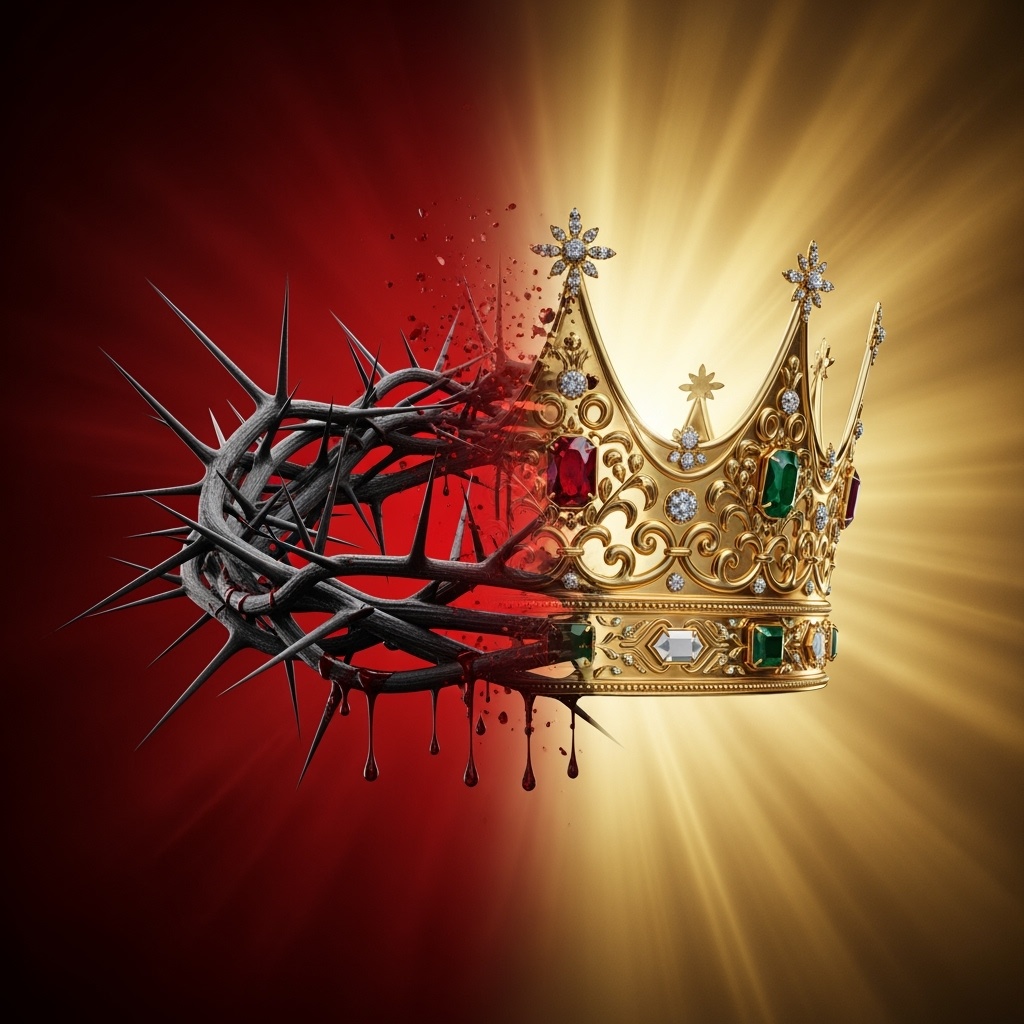
The Lamb who was slain now wears the crown.
Jesus’ ascension wasn’t just a return to heaven—it was His coronation.

When we think of a coronation, we picture crowns, trumpets, and cheering crowds. But the coronation of Jesus didn’t happen in a palace or cathedral—it happened in heaven itself. His ascension was more than a farewell; it was His enthronement. In that moment, the risen Lamb became the reigning Lion.

A Seat Beside Majesty

The writer of Hebrews puts it this way:

“When He had made purification of sins, He sat down at the right hand of the Majesty on high” (Hebrews 1:3).

That’s not symbolic fluff. Sitting at God’s right hand means sharing His authority, rule, and glory. The cross now wears a crown. This is exactly what Daniel foresaw: “One like a son of man” was given authority, glory, and sovereign power (Daniel 7:13–14).

The King Has Come

Jesus didn’t suddenly become King after the resurrection—He had always been King. From His birth, He was announced as the One who would reign on David’s throne forever. Throughout His ministry, He declared, “The kingdom of God is at hand; repent and believe” (Mark 1:15).

With that announcement, He was:

  • Declaring that God’s rule had arrived through Himself
  • Calling people to repentance and faith
  • Fulfilling centuries of prophecy
  • Planting a kingdom-seed that would one day fill the earth

Wherever the King goes, the Kingdom follows. The light of heaven invades the darkness of earth.

A King Mocked Before He Was Crowned

As Jesus entered Jerusalem on a donkey, He fulfilled Zechariah 9:9—but disappointed Jewish expectations and amused Roman ones. A donkey was no warhorse.

When Pilate asked, “Are you a king?” Jesus replied, “Yes—but my kingdom is not of this world” (John 18:36). Soldiers mocked Him with a crown of thorns, a purple robe, and sarcastic shouts: “Hail, King of the Jews!” Pilate even had the charge nailed above His head: “Jesus of Nazareth, King of the Jews.”

The irony? What they mocked was true. He is King—not just of the Jews, but of all people everywhere.

The King Proclaimed

After His resurrection and ascension, His kingship was no secret. Peter announced it at Pentecost:

“This Jesus God raised up again… exalted to the right hand of God” (Acts 2:32–33).

Paul echoed the same truth: “God raised Him… seated Him at His right hand… far above all rule and authority” (Ephesians 1:20–23).

And in Revelation, John sees the Lamb on the throne, surrounded by worshippers declaring Him worthy of all power, glory, and honor (Revelation 5:11–12).

Before His crucifixion, Jesus rode into Jerusalem on a donkey.  When He returns, He will be riding a white horse (Revelation 19).

King and Lord

Revelation 17:14 calls Him “Lord of lords and King of kings.” Those titles overlap, but they aren’t identical.

  • Lord points to our personal relationship with Him—Master and servant.
  • King points to His role as Messiah, ruling on David’s throne forever.

Together, they emphasize His total authority. Calling Him “King” means more than giving Him allegiance; it means aligning our lives with His kingdom—its culture, its values, and its mission.

What This Means for Us

Right now, Jesus reigns. His rule may be invisible on earth, but it is very real in heaven—and in the hearts of His disciples. Every act of love, every transformed life, every person who turns to Him is living evidence that the Kingdom of God is here and advancing.

The Servant is now the Sovereign. The Lamb is now the Lion. The crown of thorns has become the crown of glory.

One day, His invisible reign will be visible to every eye:

“At the name of Jesus, every knee should bow… and every tongue confess that Jesus Christ is Lord” (Philippians 2:10–11).

Looking Ahead

The King who now rules in grace will return in glory. And when He does, there will be no mocking robe or thorny crown—only majesty, power, and justice.

Stay tuned for Act 7: Justice Wears a Robe – His Examination, where Christ returns not as a Servant but as a Judge, clothed in justice and authority.

Discussion Questions

  1. How does seeing Jesus’ ascension as a coronation change the way you understand His kingship today?
  2. Why do you think people in Jesus’ day struggled to accept Him as King? In what ways do people today still struggle with that?
  3. What does it mean to say, “Wherever the King goes, the Kingdom follows”?

TADB 142: The Gospel Act 5 – Humanity Enters Heaven

Jesus didn’t shed His humanity at the clouds. He carried it into heaven—and that changes everything

Picture this: Jesus and His disciples are walking up the Mount of Olives. Only weeks before, a nearby garden had been the place of betrayal, soldiers, and fear. But now—no soldiers, no crowds, no traitor. Just a small band of men transformed by the resurrection.

For forty days, Jesus had been teaching them. He opened their eyes to see how Moses, the prophets, and the Psalms all pointed to Him. The story finally made sense.

And now, He gave them their mission: “Make disciples of all nations.” But before they could begin, He gave them one more gift—the promise of power.


The Ascension Moment

As He blessed them, Jesus began to rise into the clouds. The disciples stood in stunned silence until two angels appeared:

“Why do you stand looking into heaven? This same Jesus will return in the same way you saw Him go.” (Acts 1:11)

Instead of sadness, the disciples were filled with joy. Why? Because this wasn’t about Jesus leaving. It was about Jesus arriving.


Humanity in Heaven

The Son of God’s return to heaven wasn’t surprising. What astonished heaven was this: He returned still wearing our humanity.

As Gerrit Dawson wrote, “Humanity has now entered heaven for the first time…the incarnation has no expiration date.”

Jesus still bears the scars. He is still the God-Man. Which means humanity has a place in heaven.

Tim Keller put it simply: “The ascension means that a human being rules the universe.”


What It Means for Us

Because of the ascension:

  • We are not alone—Jesus intercedes for us as our High Priest.
  • We have direct access to God—no other mediator is needed.
  • We can pray boldly in Jesus’ name, standing in His authority.
  • The Spirit now dwells within us permanently.

Following Jesus isn’t about trying harder. It’s about leaning into the Spirit’s strength, depending on His presence, and living in His power.

The disciples finally understood:

  • The incarnation is eternal.
  • Christ’s sacrifice is accepted.
  • Reconciliation is available.
  • The Spirit is personal.
  • Intercession is direct.

So What Now?

The ascension means heaven is open, our prayers are heard, and our future is secure. We have a representative in heaven—one who carries our humanity before the throne of God.

And this story isn’t finished. The angels promised: “This same Jesus will return in the same way.”

Until then, our mission is clear: start where we are, go in every direction, and make disciples.

Christ is risen. Christ is ascended. And one day, Christ will return.

…And it gets even better.

For Discussion

  1. Why do you think the ascension of Jesus is often overlooked compared to the resurrection?
  2. What does it mean for you personally that “humanity has now entered heaven”?
  3. How does Jesus’ role as our High Priest change the way you think about prayer
  4. The disciples moved from fear to joy because of the ascension. What shift does God want to bring in your perspective?
  5. How can you live more boldly in light of the truth that Christ is both risen and ascended?

TADB 128: The Gospel of the Risen King

Rediscover the Gospel of the Risen King and guard it from distortions to fuel real discipleship and transformation in a post-Christian age.

As ambassadors of Christ and his kingdom, we need to reexamine our understanding of the first-century gospel, the gospel that the church fathers vigorously protected from various counterfeits. We need to guard that same gospel against additions, subtractions and distortions. In our attempts to abbreviate and abridge the gospel, we need to see if we haven’t skewed it, especially in light of our current audience that is biblically illiterate and post-Christian. 

The Gospel of the Risen King: A Journey to Rediscover the Power of the Gospel

For the past 60 years, discipleship has been the focus of my life and ministry. Over that time, I have shared my insights through this blog and my trilogy, Rethinking Discipleship. Both emerged from years of exploring, learning, teaching, and mentoring, all rooted in the conviction that making disciples is at the heart of the Great Commission. I still hold that conviction today.

My passion for discipleship stems from my connection with The Navigators, founded by Dawson Trotman during WWII. Trotman, an avid evangelist, once had an eye-opening moment when he picked up a hitchhiker who had committed to Christ weeks earlier but showed no signs of spiritual growth. Trotman realized that evangelism alone wasn’t enough—new believers needed continued discipleship.

This revelation led to Trotman’s collaboration with Billy Graham in the 1950s, helping to develop follow-up material for the thousands of new converts from Graham’s crusades. This focus on discipleship, or “follow-up,” has birthed numerous organizations and resources over the past 75 years. Yet, despite these efforts, a troubling question lingers: Why does spiritual fruit remain so rare in the church, even after decades of discipleship material and mentorship?

This question brings me to a deeper issue: Is it possible that the root cause of fruitlessness is not simply insufficient discipleship, but an incomplete understanding of the gospel itself?

Rethinking the Gospel

In recent years, as I’ve reflected on my understanding of the gospel, I’ve come to a significant realization: the gospel is more than just a doctrine to be asserted—it is a narrative to be told. Specifically, it is the narrative of Jesus Christ as the Risen King. This Gospel of the Risen King is the foundation of the Great Commission, and it is this message that must shape our discipleship efforts.

As I researched and reflected on the gospel, I found that I was not alone in questioning whether cultural distortions have impacted our understanding of this message. A.W. Tozer voiced similar concerns decades ago, suggesting that our failure to see moral transformation through the gospel may be tied to a failure in how the message is preached. Tozer lamented:

“Could it be that the failure of the gospel to effect moral change is due to a misunderstanding of the message itself? In earlier times, revival campaigns led to real, visible change—closing saloons and brothels as a direct result of the gospel. But today, that kind of transformation seems rare.” (A.W. Tozer, The Set of the Sail)

The Heart of the Gospel

The Gospel of the Risen King centers on the person and work of Jesus Christ as King, which is often missing from our modern presentations of the gospel. To put it simply, we must revisit the question: What is the gospel? This critical question must be answered clearly if we are to unleash its power and experience the fruitfulness we long for.

We must recognize that the gospel is not just a message about salvation from sin, but a proclamation of the Kingdom of God, which is inaugurated in Christ’s resurrection. The gospel transforms lives by transferring people from the kingdom of darkness to the kingdom of light, aligning them with Christ as King.

Paul’s words in 1 Corinthians 3:10—“Like a wise master builder, I laid a foundation, and another is building on it”—remind us that discipleship must be built on the right foundation. But if the gospel we preach is distorted, how can we expect to see the fruit of the Spirit in people’s lives?

The Challenges We Face

In my exploration, I’ve identified several cultural “pathogens”—ideas and assumptions that threaten the power of the gospel. These cultural influences undermine the gospel’s ability to bring true transformation. These pathogens have shifted our understanding of the gospel and distorted how we present it, weakening its impact.

One key issue is that many of us still approach discipleship with outdated assumptions about our audience. Our world has changed dramatically, and so must our methods of presenting the gospel. In some cases, small adaptations may suffice; in others, a more significant overhaul will be necessary.

A Call to Recenter the Gospel

The Gospel of the Risen King has the power to create new life and bring lasting transformation, but only if we protect it from distortion and preach it faithfully. As followers of the risen King, our mission is to guard this gospel, proclaim it, and expand God’s kingdom one life at a time. This involves not only defending the message but living it out, reflecting Christ’s image through the power of the Holy Spirit.

In the upcoming blogs, I will share more of my journey: searching the Scripture, asking hard questions, and challenging existing traditions on the Gospel of the Risen King. I am on a journey of sifting through long-held assumptions, and I invite you to join me in this quest for a deeper understanding of the gospel. As the Bereans did in Acts 17:11, we must be open-minded, searching the Scriptures daily to see if what we’re proclaiming is truly the gospel.

Moving Forward

I will explore the cultural pathogens that threaten the gospel and how we can counter them. I will also look at how our gospel presentations have evolved over time and how they can be renewed to better connect with today’s audience.

As we rediscover the Gospel of the Risen King, let us remember that it is more than a message to be heard; it is the story of Jesus as King, reigning over His kingdom, and calling us to live as His disciples.

For Discussion

        1. What is the distinction between a “doctrine” of the gospel and the “narrative” of the gospel? How does understanding the gospel as a narrative affect our discipleship efforts?

          2. In what ways do we see the Gospel of the Risen King being under attack today? How can we protect and preserve its true message?

          3. How does the resurrection of Jesus as King change the way we understand the gospel? Why is it significant to view the gospel through the lens of the risen Christ as opposed to merely the crucified Christ?

          4. What cultural pathogens (distortions or misunderstandings) do you think are most common in the presentation of the gospel today? How can we address these in our own lives and ministries?

          5. How do we reconcile the fact that, despite a wealth of discipleship resources, many people still struggle with spiritual growth? What could be the missing ingredient?