TADB 131: Protecting the Treasure

Like the Dead Sea Scrolls, the gospel is a priceless treasure that must be preserved intact—protected from any additions that could alter its truth.

It was 1947 in the barren Judean hills near the Dead Sea. Two Bedouin shepherds roamed the rocky slopes, searching for goats that had strayed from the herd. The sun beat down. The air was still. Then one of them spotted a narrow opening in the cliffs. Perhaps the animals had taken shelter there.

Bending down, he tossed a rock inside. Instead of a bleating goat, the air was filled with the sharp crack of breaking pottery. The sound was strange—almost eerie—and it would one day be heard around the world.

Inside the dark cave stood several clay jars. Some lay shattered; others remained sealed. Expecting treasure, the shepherds opened them, only to find old parchment scrolls wrapped in linen, their surfaces blackened with age. Disappointed, they sold the scrolls to an antiquities dealer. Eventually, the manuscripts reached a monastery in Jerusalem, where they were handled casually—until someone recognized their true value.

These were the oldest surviving manuscripts of the Jewish Scriptures, dating back to around 200 BC. Over the next decade, more caves would be discovered, yielding fragments from over 900 manuscripts.

By the early 1990s, the Israel Antiquities Authority established a dedicated conservation lab to preserve these fragile treasures. What had once been dismissed as worthless was revealed to be one of the most valuable archaeological finds in history—worthy of reverence and protection.

The gospel is like that. It is a priceless treasure entrusted to each generation—not only to proclaim, but also to guard, preserve, and pass on intact to those who come after us.

Paul: Preacher and Protector

The Apostle Paul was not only a herald of the gospel but also its guardian. He knew the message could be distorted—by additions, subtractions, or outright alterations—and warned Timothy to protect it:

Guard, through the Holy Spirit who dwells in us, the treasure which has been entrusted to you.
— 2 Timothy 1:14 (see also 1 Timothy 6:20)

In this article, we’ll examine the first danger Paul identified: additions to the gospel.

  1. Guarding Against Additions

After their first missionary journey, Paul and Barnabas returned to Antioch, where the gospel had taken root among Jews and Gentiles alike. But trouble soon arrived in the form of certain Jewish believers from Jerusalem, who insisted that circumcision was necessary for salvation.

Adding circumcision meant adding works to faith and merit to Christ’s righteousness. In Luke’s understated words, Paul and Barnabas had “no small dissension” with them (Acts 15:2). In modern terms—Paul was livid.    

To settle the matter, the Antioch church sent a delegation, including Paul and Barnabas, to Jerusalem to consult the apostles and elders. The issue was clear: if the gospel was to cross cultural boundaries, it had to be free from the weight of religious tradition and cultural baggage.

When the leaders gathered, Paul testified how God had worked among the Gentiles without requiring circumcision. Peter concluded:

“But we believe that we are saved through the grace of the Lord Jesus, in the same way as they also are.” — Acts 15:11

Verdict: circumcision is not essential to the gospel. Leave it out.

Armed with a letter from Jerusalem, the delegation returned to Antioch with clarity. But the danger wasn’t gone. In Galatia, Paul faced the same problem—Jewish believers trying to elevate law-keeping into a mark of “higher” spirituality. Paul’s response was sharp:

I am amazed that you are so quickly deserting Him who called you by the grace of Christ, for a different gospel; which is really not another… (Galatians 1:6–7)

Peter’s error in separating from Gentile believers gave Paul the opportunity to reaffirm the heart of the gospel.

Modern Additions

We face the same temptation today—to “add a little something” to the simple call of the gospel. Over time, small cultural additions can become entrenched traditions that subtly alter the message.

One example is the phrase, “Invite Jesus into your heart” as the response to the gospel. It’s well-meaning, but it’s never found in Scripture. Likely drawn from a misreading of Revelation 3:20, it was popularized through Holman Hunt’s 1853 painting The Light of the World. This image of Jesus knocking on a door became a standard evangelistic illustration in sermons, hospitals, and homes.

The shift, though subtle, is significant: from God’s invitation for us to enter His kingdom, to us inviting Him into our personal kingdom. It feeds the very self-focus the gospel came to transform.

Guard the Treasure

Just as the Dead Sea Scrolls had to be handled with care to preserve their original form, so the gospel must be safeguarded against human alterations. Additions—no matter how small—risk obscuring the glory of grace with the dust of our own traditions.

In every generation, the call is the same: proclaim the gospel faithfully, guard it diligently, and pass it on unaltered.

For Discussion

  1. Why was Paul so passionate about guarding the gospel against additions like circumcision?
  2. How does Paul’s confrontation with Peter in Galatians highlight the seriousness of preserving the gospel’s purity?
  3. Can you think of modern examples where well-meaning traditions or phrases have subtly altered the gospel message?
  4. What is the difference between inviting Jesus into our lives and responding to His invitation to enter His kingdom?
  5. What additions or distortions to the gospel have you encountered in your own Christian experience?


TADB 130: The God We Present Shapes the Gospel We Share

A distorted view of God distorts the gospel. Discover why the early church clarified God’s nature, how today’s culture misrepresents Him, and why gospel conversations must begin with “What is your picture of God?”

What comes to mind when you think about God?  Your answer will shape how you live, how you view yourself, and how you respond to the gospel. It is not a small matter. The early church knew this well—and so should we.

From Acts to the Creeds: Clarifying God’s Nature

The book of Acts shows the apostles adapting their message for audiences with very different pictures of God. They knew that unless God’s nature was presented clearly, the gospel could be misunderstood.

In the first centuries of the church, this same need for clarity led to the creeds. While much of their focus was on affirming Jesus as both God and man, they began with an uncompromising statement about God the Father:

“I believe in one God, the Father Almighty, Maker of heaven and earth, and of all things visible and invisible.” — Nicene Creed

The implication was clear: if we are wrong about God, we will be wrong about the gospel.

The Changing Picture of God in Our Culture

For many years, gospel conversations in America assumed a shared starting point—most people held a Catholic/Protestant view of God as Creator, holy, sovereign, and judge. The only missing piece, in many cases, was the personal love of God.

That is no longer the case.

  • Pew Research Center reports that absolute certainty in God’s existence has declined sharply.
  • American Worldview Inventory reveals that only 6% of U.S. adults have a biblical worldview—and Americans are now more confident in Satan’s existence than in God’s.
  • Only half of the nation accepts the biblical picture of God as Creator, sovereign, omnipotent, omniscient, and perfectly just.

Even more telling: 71% of Americans believe God loves them unconditionally—often with a sentimental “Santa Claus” image—but many reject His holiness, justice, and authority.

As George Barna notes, “It’s no wonder that more than nine out of ten Americans lack a biblical worldview given that people’s fundamental understanding of the nature and existence of God is flawed.”

Why Our Picture of God Matters for the Gospel

Our picture of God is the starting point for understanding the gospel. If we add Jesus to a distorted view of God, we produce a distorted faith. If God is a cosmic genie, then the gospel becomes about self-fulfillment, not repentance, kingdom transfer, and new creation.

I learned this decades ago while sharing “The Bridge” illustration. I would draw two cliffs—God and Man—and ask people to describe God. Their answers were usually orthodox: Creator, holy, sovereign, and just. This provided the perfect opening to add God’s love to the picture and introduce Jesus.

Today’s answers are different. God is seen as loving but rarely as Creator, holy, sovereign, or just. Without these truths, the gospel loses its context and urgency.

A Biblical Starting Point

Before someone can grasp the good news of Jesus, they must first meet the God who is its source. The Old Testament gives us essential truths about Him:

  • There is one God (Deut. 6:4; Isa. 46:9).
  • God is eternal—self-existent, without beginning (Gen. 1:1).
  • God is the creator of all things seen and unseen (Gen. 1:1; Isa. 45:18).
  • God is relational—seeking fellowship with His creation (Gen. 3:8).
  • God is sovereign—the owner and ruler of all He has made (Isa. 40:21–26).
  • God is holy—morally pure, completely separate from evil (Isa. 6:1–5).
  • God is just—the perfect judge of righteousness (Isa. 61:8).
  • God is loving—kind, merciful, and compassionate (Psalm 136; Isa. 63:7–8).

These truths shape the way we present the gospel. Without them, Jesus’ life, death, and resurrection can be reduced to a vague act of kindness rather than the decisive rescue mission of the Creator-King.

Helping People Take the First Step

Dr. James Engel’s “Scale of Spiritual Decision” begins at stage -8: discovering that God exists and learning who He is. From there, people progress toward understanding and embracing the gospel. Our task is not to rush them to the cross without first introducing them to the God of the cross.

So before we explain what Jesus has done, perhaps the most important question we can ask is:

“What is your picture of God?”

Because, as A.W. Tozer warned, “The gravest question before the Church is always God Himself.”

For Discussion

1.  How do Old Testament truths about God (Creator, sovereign, holy, just, loving) prepare the way for understanding the gospel?

2.  What differences do you see between how past generations in America viewed God and how people view Him today?

3.  Why do you think so many Americans believe in God’s love but reject His holiness and justice?

4.  What questions could you ask in a conversation that might surface someone’s unconscious assumptions about God?

5.  If you had to summarize your own “picture of God” in three words, what would they be—and why?

TADB 129: Our View of God Matters

Our view of God shapes everything about us. Drawing from A.W. Tozer’s The Knowledge of the Holy and the Acts 1:8 strategy, this article explores how the early church shared the gospel of the kingdom across cultures—from Peter and Cornelius to Paul in Athens. Discover why understanding a person’s concept of God is essential before presenting the gospel, and how Paul’s Areopagus sermon shows a model for engaging different worldviews in evangelism today.

“What comes into our minds when we think about God is the most important thing about us… we tend, by a secret law of the soul, to move toward our mental image of God.” – A.W. Tozer, The Knowledge of the Holy

Tozer’s insight is more than a devotional thought—it’s a missional necessity. Every person carries an internal image of God, whether accurate or distorted, and this image shapes how they respond to the gospel. If we want to proclaim the gospel of the risen King effectively, we must first address the hearer’s concept of God.

The Unconscious Picture of God

Each of us has a default picture—often a caricature—of God lodged deep in our unconscious mind.  It is rarely the result of careful study; rather, it is formed by anecdotal experiences, influential figures, cultural messages, and personal assumptions. Without correction by biblical revelation, these views remain flawed. When we ask, “What is God like?” we are touching the foundation of gospel proclamation. If that foundation is wrong, the structure of the gospel will not stand.

The Acts 1:8 Expansion Pattern

After His resurrection, Jesus told His disciples to wait for the Holy Spirit, then to be His witnesses: “In Jerusalem, and in all Judea and Samaria, and even to the remotest part of the earth” (Acts 1:8).

This was not only a geographical expansion—it was also a worldview expansion. As the gospel moved outward, the apostles encountered audiences with increasingly different views of God.

1. Jerusalem – Shared View of God

At Pentecost, Peter addressed Jews from many regions. While their customs varied, they all recognized Yahweh as revealed in the Hebrew Scriptures. Peter could proclaim Jesus directly as Messiah because the foundation of God’s nature was already in place.

2. Samaria – Partial Agreement

Philip preached in Samaria to people who worshipped Yahweh but had different cultural and religious practices. Their concept of God was close enough to make a direct connection to Jesus, yet distinct enough to require clarification.

3. Damascus – Still Within Jewish Boundaries

Paul’s first post-conversion ministry was in Damascus, speaking in synagogues to Jews. Again, he could begin with the Messiah because the audience already understood the God of the Scriptures.

4. Caesarea – God-Fearers

Peter’s meeting with Cornelius (Acts 10) marked the gospel’s first recorded entry into a Gentile setting. Cornelius was a God-fearer—a Gentile who worshipped Yahweh but had not fully adopted Jewish practices. Peter still began with Jesus because Cornelius already shared the biblical view of God.

5. Athens – A Different God Altogether

Athens was different. When Paul arrived (Acts 17), he found:

  • Stoics – Believed God was the rational order in nature (pantheistic, impersonal).
  • Epicureans – Believed in distant gods uninvolved in human affairs; the goal was personal tranquility.

These views had little in common with the biblical picture of God. Paul could not start with Jesus as Messiah; first, he had to reframe who God is.

Paul’s Athens Strategy

Paul began with their altar “To the Unknown God” and used it as a bridge.
He described Yahweh in terms they had never heard:

  1. Creator of all – Maker of heaven and earth, distinct from creation.
  2. Sovereign Lord – Master over all nations and history.
  3. Not confined to temples – Beyond human-made structures.
  4. Self-sufficient – Needs nothing from humans.
  5. Giver of life – Source of breath and all good things.
  6. Origin of humanity – From one man, every nation was made.
  7. Near yet invisible – Wants to be known, not distant.
  8. Totally other – Cannot be reduced to idols.
  9. Righteous Judge – Will hold all accountable.
  10. Appointed a Man – Jesus, validated by resurrection, will judge the world.

Only after establishing God’s nature did Paul introduce Jesus. This progression gave the gospel a foundation that made sense to their worldview.

The Missional Principle

When the audience shares the biblical view of God, we can move quickly to the person and work of Jesus.  When they do not, we must start earlier—by clarifying who God is—before explaining what He has done in Christ.

Today’s “Athens”

Modern evangelism often assumes people already have a basic understanding of God. But in our post-Christian, religiously plural world, many have views of God that resemble Athens more than Jerusalem.

  • Some see God as an impersonal force (New Age spirituality).
  • Others see Him as distant and uninvolved (secular deism).
  • Many see Him as a projection of personal preference.

In such cases, we must start where they are—just as Paul did—patiently building a biblical view of God before proclaiming the risen King.

Conclusion

Paul’s example in Athens teaches us that the gospel must rest on the right foundation: the truth about God Himself. Without that foundation, the message of Jesus will be misunderstood or rejected outright.

If they do not know the God of the Bible, begin there. If they do, proclaim Christ. Always start where they are—so you can lead them to where He is.

For Discussion

  1. How has your own “picture of God” been shaped by family, culture, or personal experience?
  2. What happens when people try to receive Jesus without first understanding who God truly is?
  3. How did Peter’s message at Pentecost differ from Paul’s message in Athens?
  4. In your experience, how do people around you view God today? (Impersonal force? Distant deity? How does this affect the way we share the gospel?

TADB 128: The Gospel of the Risen King

Rediscover the Gospel of the Risen King and guard it from distortions to fuel real discipleship and transformation in a post-Christian age.

As ambassadors of Christ and his kingdom, we need to reexamine our understanding of the first-century gospel, the gospel that the church fathers vigorously protected from various counterfeits. We need to guard that same gospel against additions, subtractions and distortions. In our attempts to abbreviate and abridge the gospel, we need to see if we haven’t skewed it, especially in light of our current audience that is biblically illiterate and post-Christian. 

The Gospel of the Risen King: A Journey to Rediscover the Power of the Gospel

For the past 60 years, discipleship has been the focus of my life and ministry. Over that time, I have shared my insights through this blog and my trilogy, Rethinking Discipleship. Both emerged from years of exploring, learning, teaching, and mentoring, all rooted in the conviction that making disciples is at the heart of the Great Commission. I still hold that conviction today.

My passion for discipleship stems from my connection with The Navigators, founded by Dawson Trotman during WWII. Trotman, an avid evangelist, once had an eye-opening moment when he picked up a hitchhiker who had committed to Christ weeks earlier but showed no signs of spiritual growth. Trotman realized that evangelism alone wasn’t enough—new believers needed continued discipleship.

This revelation led to Trotman’s collaboration with Billy Graham in the 1950s, helping to develop follow-up material for the thousands of new converts from Graham’s crusades. This focus on discipleship, or “follow-up,” has birthed numerous organizations and resources over the past 75 years. Yet, despite these efforts, a troubling question lingers: Why does spiritual fruit remain so rare in the church, even after decades of discipleship material and mentorship?

This question brings me to a deeper issue: Is it possible that the root cause of fruitlessness is not simply insufficient discipleship, but an incomplete understanding of the gospel itself?

Rethinking the Gospel

In recent years, as I’ve reflected on my understanding of the gospel, I’ve come to a significant realization: the gospel is more than just a doctrine to be asserted—it is a narrative to be told. Specifically, it is the narrative of Jesus Christ as the Risen King. This Gospel of the Risen King is the foundation of the Great Commission, and it is this message that must shape our discipleship efforts.

As I researched and reflected on the gospel, I found that I was not alone in questioning whether cultural distortions have impacted our understanding of this message. A.W. Tozer voiced similar concerns decades ago, suggesting that our failure to see moral transformation through the gospel may be tied to a failure in how the message is preached. Tozer lamented:

“Could it be that the failure of the gospel to effect moral change is due to a misunderstanding of the message itself? In earlier times, revival campaigns led to real, visible change—closing saloons and brothels as a direct result of the gospel. But today, that kind of transformation seems rare.” (A.W. Tozer, The Set of the Sail)

The Heart of the Gospel

The Gospel of the Risen King centers on the person and work of Jesus Christ as King, which is often missing from our modern presentations of the gospel. To put it simply, we must revisit the question: What is the gospel? This critical question must be answered clearly if we are to unleash its power and experience the fruitfulness we long for.

We must recognize that the gospel is not just a message about salvation from sin, but a proclamation of the Kingdom of God, which is inaugurated in Christ’s resurrection. The gospel transforms lives by transferring people from the kingdom of darkness to the kingdom of light, aligning them with Christ as King.

Paul’s words in 1 Corinthians 3:10—“Like a wise master builder, I laid a foundation, and another is building on it”—remind us that discipleship must be built on the right foundation. But if the gospel we preach is distorted, how can we expect to see the fruit of the Spirit in people’s lives?

The Challenges We Face

In my exploration, I’ve identified several cultural “pathogens”—ideas and assumptions that threaten the power of the gospel. These cultural influences undermine the gospel’s ability to bring true transformation. These pathogens have shifted our understanding of the gospel and distorted how we present it, weakening its impact.

One key issue is that many of us still approach discipleship with outdated assumptions about our audience. Our world has changed dramatically, and so must our methods of presenting the gospel. In some cases, small adaptations may suffice; in others, a more significant overhaul will be necessary.

A Call to Recenter the Gospel

The Gospel of the Risen King has the power to create new life and bring lasting transformation, but only if we protect it from distortion and preach it faithfully. As followers of the risen King, our mission is to guard this gospel, proclaim it, and expand God’s kingdom one life at a time. This involves not only defending the message but living it out, reflecting Christ’s image through the power of the Holy Spirit.

In the upcoming blogs, I will share more of my journey: searching the Scripture, asking hard questions, and challenging existing traditions on the Gospel of the Risen King. I am on a journey of sifting through long-held assumptions, and I invite you to join me in this quest for a deeper understanding of the gospel. As the Bereans did in Acts 17:11, we must be open-minded, searching the Scriptures daily to see if what we’re proclaiming is truly the gospel.

Moving Forward

I will explore the cultural pathogens that threaten the gospel and how we can counter them. I will also look at how our gospel presentations have evolved over time and how they can be renewed to better connect with today’s audience.

As we rediscover the Gospel of the Risen King, let us remember that it is more than a message to be heard; it is the story of Jesus as King, reigning over His kingdom, and calling us to live as His disciples.

For Discussion

        1. What is the distinction between a “doctrine” of the gospel and the “narrative” of the gospel? How does understanding the gospel as a narrative affect our discipleship efforts?

          2. In what ways do we see the Gospel of the Risen King being under attack today? How can we protect and preserve its true message?

          3. How does the resurrection of Jesus as King change the way we understand the gospel? Why is it significant to view the gospel through the lens of the risen Christ as opposed to merely the crucified Christ?

          4. What cultural pathogens (distortions or misunderstandings) do you think are most common in the presentation of the gospel today? How can we address these in our own lives and ministries?

          5. How do we reconcile the fact that, despite a wealth of discipleship resources, many people still struggle with spiritual growth? What could be the missing ingredient?

          TAD Blog 125: Composing Your Life Song

          We have been developing the privilege, process, and practice of discovering God in the landscapes of our daily lives. Discovering God is based on the reality that God wants to be discovered and has revealed himself in various ways so that everyone can know firsthand the God of the universe. It sounds incredible – even too good to be true. 

          The Old Testament narrative tells us that humanity’s rebellion thwarted God’s desire to be known early in our historical timeline. As a result, we were exiled from God’s presence and connection to his story. Living out our own story, separated from God, we lack the spiritual capacity to know him relationally.   Paul describes it as being dead.

          Yet, the gospel of Jesus Christ brings us the exciting news of a way back, a way to reconnect to God’s story and rediscover our own narrative intricately woven into the grand tapestry of his. This is not just theoretical knowledge but a personal, intimate ‘knowing God’ that Paul describes as his ultimate desire. ‘More than that, I count all things to be loss, given the surpassing value of knowing Christ Jesus my Lord’ (Philippians 3:8).

          Scripture tells us about God, but we can only know him by encountering Him in the landscapes of our daily lives. The biblical narrative introduces us to men and women who have discovered God. Their stories are not to be a vicarious experience but rather a catalyst for discovering God in our storyline.

          Moses was after knowing God when he said, “Show me your glory.”  Sometimes, God shows up in dramatic, hard-to-miss ways, yet at other times, he hides in plain sight where we need to use our lens of faith to see the evidence left behind. We referred to this discovery technique as a CSI (Christ Scene Investigation).  (See chapter _______)

          We mentioned previously that God wants us to know him and others to know him because of our testimony. David illustrated this in Psalm 40:3: “He put a new song in my mouth, a song of praise to our God; Many will see and fear and will trust in the LORD.”

          The apostle John was even more explicit as he began his first letter. “What was from the beginning, what we have heard, what we have seen with our eyes, what we have looked at and touched with our hands, concerning the Word of Life— and the life was revealed, and we have seen and testify and proclaim to you the eternal life, which was with the Father and was revealed to us— what we have seen and heard we proclaim to you also, so that you too may have fellowship with us; and indeed our fellowship is with the Father, and with His Son Jesus Christ” (1 John 1:1-3).

          To share our God discovery, we must first identify those defining moments where God shows up. When we encounter God’s presence in our storyline, we have the basis for composing what I am calling our Life Song.   Our Song comprises various verses, each expressing an encounter with God in a particular landscape. The following are suggested ways to capture your Life Song so you can play (sing/share) it with others. 

          Steps for composing your Life Song.

          1. Identify and describe briefly a defining moment in your past

            I use a defining moment to describe a kairos moment, a short or long period with a significant experience in your chronos (linear time) storyline. 

            There are two words for time in the Greek language. One is chronos time, the linear duration expressed in hours, days, and weeks:  chronological time. Another is kairos time. Kairos time refers to a moment, season, or opportune time. Kairos time is not concerned with the length of time but with the significance of the time. While chronos is quantitative, kairos has a qualitative meaning (See TAD Blog 91). Our life stories are comprised of defining (kairos) moments of various intensity and duration

            • How did he meet your needs? 
            • Who was involved?
            • What was accomplished?
            • You may need your CSI lens of faith to see the evidence of God’s presence. Often, God shows up dressed in ordinary street clothes. (Remember the disciples on the road to Emmaus.)

            2. How did you see God show up during that time? 

            Since God has promised to be with us wherever we go, the question is not whether God showed up, but how he did, and did we recognize him?

            In Romans 1, Paul describes the devastating moral slide on those who fail to recognize the nature of God when he shows up in creation. Moses warned the Hebrew people that they would take credit for God’s blessing if they did not recognize and remember the touch of God (Deuteronomy 8).

            3. What character trait of God was the most evident:  faithfulness, sovereignty, goodness, etc.?

            4. How would you finish the statement, God was my ________?

            5. Ascribe a name to God that would identify what he did.

            • A name already used in Scripture.
            • A name not found in Scripture but is yet descriptive. (David calls God his Rock, Shelter, Banner, and Shepherd in the Psalms.)

            6. Compose this verse of your song.

            Write out your narrative using #1-5 above. 

            Psalm 40:1-3 is a highly abbreviated Song from David. “I waited patiently for the LORD, And He reached down to me and heard my cry. He brought me up out of the pit of destruction, out of the mud, And He set my feet on a rock, making my footsteps firm.” 

            7. Share your song with a friend or family member. You can start by saying, “Did I ever tell you about a time in my life when God showed up in a significant way?”  “One generation shall praise Your works to another and shall declare Your mighty acts” (Psalm 145:4). 

            8. Can a visual marker help you remember this encounter with God?

            9. Expand your Life Song by dividing your life into decades. Identify at least one defining moment in each one. Do steps 1-5 above with each one.

            Review

            • God is writing your story into his.
            • Your Life Song is the collection of defining moments (verses) when God showed up in a significant way.
            • Your life song is your spiritual heritage you need to pass on to the next generation.

            It is ultimately about God, not us. Our Life Song brings God glory as it lifts him up. When we share it, we are saying God showed up in my life, and he will in yours if you look for him.

            For Reflection

            1.  Identify one defining moment following steps 1-4.
            2. Share it with someone.

            TADB 112: Discovering God in the Mountain Meadow

            Years ago, my wife and I went on an ATV trip in mid-July, negotiating part of the Alpine Loop in southwestern Colorado.  The trail was challenging but not dangerous.  Working our way over the rocks and ruts, we steadily climbed above the tree line at about 12,000 feet.  There the trail leveled off and we arrived at our planned destination. 

            Looking off to our left, nestled between the mountain peaks, was a lovely alpine meadow called the American Basin.  We were told about its beauty, and we were not disappointed.  The meadow bloomed with wildflowers and a stream, fed by the runoff from the snow still on the peaks ahead, gently flowed through it.   Crossing the creek to get further into the meadow, we looked up on the distant peaks and saw a prospector with his pack mule slowly making his way up a twisting trail far in the distance.

            It was a place of tranquil beauty unspoiled by noisy people, picnic tables or manufactured objects.  Once we shut off our ATVs, the only sound was that of the creek as it made its way over the rocks.  It was a moment of peace.  Resting from the effort of our climb, we soaked in the solitude and natural beauty displayed around us.  We even took a few moments to dream of living in the meadow.  We could picture a small log cabin in the middle of the flowers, smoke lazily drifting from the fireplace as we sat in rocking chairs on the front porch, sipping our mugs of coffee and gazing at the distant mountains.  However, afternoon storms are typical at this season and elevation, so we knew we could not stay long.  We needed to head back down below the tree line before it arrived.

            Dreaming is enjoyable, but the reality is even Alpine meadows do not continuously bloom with flowers.  After a few short months of spring and summer, winter sets in and no one would be sitting on the front porch of their cabin.  It is the same with life’s meadows.  They are a welcome part of our life journey but are usually brief.  They give us a moment of awe and wonder, a glimpse of something not yet, a taste of what we lost back in the first chapters of Genesis, and a hope of what will be restored at the coming of our King.  Then the meadows are gone and a new landscape of life arrives. 

            Mt. Meadow Landscape

            My picture of life’s meadows is like the Alpine American Basin filled with wildflowers, soft sunshine, peace, and quiet with no freeways, skyscrapers, or congestion.   The air is clear, the temperature warm, and the humidity low.  But that is just me.  You may have a different picture and that is OK.  Paint your own equivalent landscape as we take a moment to travel through the “mountain meadow landscape”.

            Life’s mountain meadows are places for spiritual, emotional, and physical refreshment.  They are places where we have a sense of “it doesn’t get any better than this” – at least not this side of heaven.  There is not only the presence of beauty but the absence of what is unpleasant.  We are at peace; joy is felt but hard to express (1 Peter 1:6-8).  But as wonderful as it is, we usually will not spend much time in the meadow before moving on.  Of all the landscapes, our stay in this one seems disappointingly brief.

            The cosmos

            Several mountain meadows come to mind as I think through the biblical storyline.  The Psalmist shares a mountain meadow moment in Psalms 8.

            When I consider Your heavens, the work of Your fingers, The moon and the stars, which You have set in place; What is man that You think of him, And a son of man that You are concerned about him?  Yet You have made him a little lower than God, And You crown him with glory and majesty!  You have him rule over the works of Your hands; You have put everything under his feet, All sheep and oxen, And also the animals of the field, The birds of the sky, and the fish of the sea, Whatever passes through the paths of the seas.  LORD, our Lord, How majestic is Your name in all the earth!  (Psalm 8:3-9)

            For the Psalmist, creation stirred awe in his heart with humble gratitude … as it should for us.

            The Transfiguration

            Jesus took three original disciples to a “high mountain” where he was transfigured before them (Matt. 17:1+).  We are told that his garments became “radiant and exceedingly white,” Elijah and Moses appeared, dialoguing with Jesus, and a voice is heard from heaven saying, “This is my beloved Son, with whom I am well-pleased; listen to him.”  It had to be a “wow” moment for those three Hebrew men.

            Peter’s response was (my paraphrase), “It does not get any better than this!  Let’s set up camp and stay for a while.”  But the meadow was only a short respite.  Descending the mountain meadow, they were quickly back on the battlefield, encountering a man with a lunatic son and nine frustrated disciples.

            The Emmaus Road

            Christ’s post-resurrection appearance to Cleopas and his friend as they walked on the road to Emmaus was another mountain meadow.  For a short time, these men were in the presence of the risen Christ as he explained the historical narrative of the gospel message.  As evening approached, they wanted to linger in the meadow, urging this stranger to stay longer.  But after dinner, he left.  Having finally recognized the stranger as Christ, they returned to their ordinary lives with the reflection, “Were not our hearts burning within us?” (The good kind of heartburn).

            Mary experienced a mountain meadow when Christ came to visit her and Martha.  Time flew by as she sat at his feet, listening to his words.  On the other hand, Martha missed it with her preoccupation with responsibility and duty.  Jesus’ gentile rebuke to Martha was over her choice not to spend a moment in the meadow (Luke 10:38-42).

            Over 5,000 people had a meadow experience one day as they sat on the hillside listening to Jesus teach about the kingdom.  Their hearts were touched, and their sick were healed; time flew by.  In the meadow, they forgot about their hunger until the disciples finally brought it up.  The day ended with a surprise dinner and enough food for a “to-go” box.  Like all mountain meadows, it did not last long, but I can imagine they talked about it for a long time. 

            God shows up

            In the mountain meadow, God often appears as our Good Shepherd, leading us into green pastures.  “The Lord is my shepherd; I shall not want.  He makes me lie down in green pastures; He leads me beside quiet waters.  He restores my soul; He guides me in the paths of righteousness For His name’s sake” (Psalm 23:1-3).  In the meadow, the Good Shepherd restores our souls and refreshes our spirits.

            He may also show up as the grand Creator, God Almighty, El Elohim, the One who does above and beyond what we could ask or think (Ephesians 3:20).   In the meadow, we are overwhelmed by his grace and love and our unworthiness of it.

            Response

            In the landscape of the meadow, we feel a unique sense of joy and contentment.  It may not be in the total absence of conflict, but it is like an oasis in the desert, a moment when nothing else matters.  We feel a sense of joy and tranquility, the temporary absence of conflict, anxiety, and adversity, a moment we would like to stay in forever.  In the mountain meadow, we experience a moment of rest, joy, and happiness that dominates all other landscapes.

            We need to be careful not to miss the meadow moments in which we learn to rest, relax, and take a deep breath.  In those times, praise and thanksgiving flow naturally and spontaneously as we experience God’s greatness and recognize our own personal inadequacy.  It is a time in which we can exchange our hurried agendas for a look around at the meadow, enjoying it to the fullest. 

            Jesus had the mountain meadow in mind when he said, “Come to Me, all who are weary and heavy-laden, and I will give you rest.  Take My yoke upon you, and learn from Me, for I am gentle and humble in heart; and you shall find rest for your souls” (Matthew 11:28-29).

            Here is a quick summary of the landscapes we have considered so far:

            LandscapeAffect I feel……God’s touch God is my….Our response I need to……Scripture
            Stormshelpless, fear, overwhelmedDeliverer, Anchor, Shelter, Sustainerhold on, wait, hopeIsa. 25:4; Matt.  7:24+ Ps. 107:28-32; Ecc. 11:5 Isa. 64:4
            Battlefieldsthreatened, fear, vulnerableFortress, Defender, Protector, Shieldfight, armor up, flee,Eph. 2:2-3, 6:13; Jam. 4:7 1 Peter 5:8; Matt. 4:1-11
            Thorn Countrytrapped, fear, guilt, weak, hopelessProvider, El Shaddai, All-Sufficient Onewait, remember, hope, be content2 Cor. 12:7+; Jn. 13:7 Jn. 19:5
            Mountain Meadowshumbled, contentment joy, awe, wonderCreator, Shepherd,  praise, express gratitude, restPsa. 8; 145, Matt.  11:28-29

            For Reflection:

            1.  Describe a time when you felt you were in a mountain meadow of life.

            2.  In what other ways does God show up in the meadow?

            TADB 95: Show Me Your Glory

            The glory of God seems like a topic for theologians like JI Packer, AW Tozer, DA Carson, RC Spraul, and CS Lewis.  (Why do they all have initials for their first name?)  But when we do think about it, what comes to mind:  a fuzzy cloud, a pillar of fire, misty haze over the Ark of the Covenant, or Moses’ glowing face after meeting with God?  Medieval painters tried to capture it with a halo around the heads of saints.

            Although usually a religious term, glory refers to the expressed nature or radiant beauty, a distinguished quality or asset of a person or thing.1

            In our solar system, visible light is the primary expression of the sun’s glory along with ultraviolet light, heat, and radio waves.  These various forms of electromagnetic energy are the sun’s glory (expressions, attributes) but not the sun’s essence.  The sun’s essence is different from its expressions.  The sun’s essence involves the thermonuclear fusion of hydrogen into helium, where its expressions involve light and other electromagnetic radiation. 

            The terms glory, attributes, or character all refer to God’s divine nature.  Scripture also uses the term “His name,” not as a delineator between people, but to represent the composite of His attributes. 

            Principle #1:  God’s glory expresses His essence through His attributes.

            The divine attributes are what we know to be true of God.  …

            They are how God is as He reveals Himself to His creatures.2

            When Moses encountered God in the desert at the burning bush, he asked, “Who shall I say sent me?”  God gives him the closest description we have of God’s essence when He says, “I AM WHO I AM” (Exodus 3:14).  As Moses returns to Egypt and challenges Pharoah to release the Israelites, God begins to manifest the attributes of the “I Am” to Moses and Pharoah through the various displays of God’s power over the plagues. 

            Later, as Moses and the Israelites camp at Mt Sinai, Moses appeals to God, “Show me your glory.”  His request was not an essence question but an attribute one.  Moses is asking for a personal demonstration of the attributes of the God who calls Himself “I Am” (Exodus 33:18). 

            Principle #2: God expresses His glory most clearly through the incarnation of Christ.

            God’s ultimate answer to the request “show me your glory” came with the incarnation of His Son.  John begins his Gospel with the declaration, “And the Word became flesh, and dwelt among us; and we saw His glory, glory as of the only Son from the Father, full of grace and truth” (John 1:14).  Paul repeats this same thought when writing to the Corinthians.  “For God, who said, ‘Light shall shine out of darkness,’ is the One who has shone in our hearts to give the Light of the knowledge of the glory of God in the face of Christ” (2 Cor. 4:6).  During Christ’s final days with his disciples, Philip repeats Moses’ request by saying, “Show us the Father.”  To which Jesus replied, “He who has seen me, has seen the Father” (John 14:9; 2 Cor. 4:6).              

            Jesus said, “It is finished,” only two times.  One was on the cross; the other was before the cross in His John 17 prayer to the Father.  “I glorified You on the earth, having accomplished the work which You have given Me to do” (John 17:4).  He then explains the work He had accomplished, “I have manifested Your name to the men whom You gave Me out of the world” (John 17:6 emphasis added).  The word manifest means to show, make visible or demonstrate.  So then, Christ claims that He had finished His mission of glorifying the Father by making visible His attributes to those disciples who followed Him. 

            Jesus, then, concludes his prayer with, “Father, I desire that they also, whom You have given Me, be with Me where I am, so that they may see My glory which You have given Me” (John 17:24).  (The glory he had before the world was John 17:5.)  The glory Jesus manifested while He was on the earth is only part of His glory.  Evidently, there is more for us to see, and it will take our resurrected bodies and all of eternity to explore it.

            Principle #3: God’s glory needs a context for its expression.

            God shows His glory most universally in creation.  David wrote, “The heavens proclaim the glory of God.  The skies display his craftsmanship.  Day after day they continue to speak; night after night they make him known” (Psalm 19:1-3 NLT).  Many of the early scientists who discovered our physical laws saw the fingerprint of God in their discoveries.  Paul wrote the Romans and said that nature shows to all men God’s invisible attributes, His eternal power, and divine nature (Rom. 1:20).

            God also has shown His glory through the Scriptural narrative.  The storyline of the Bible is how God reveals Himself to humanity first through the Patriarchs and then through Israel, His chosen people.  Their journey to discover what Yahweh is like is also our journey.  As we travel with the men and women of Bible history, we learn along with them.  Their struggle to get it right is our struggle.  We can quickly identify with their successes and failures.

            God responded to Moses’ request to show him His glory with an Illustration.  He said that Moses could not look directly at his glory but only see it after He had “passed by.”  Hidden in the safety of a cave, God shielded Moses showing only “His back.”  Moses learned several principles about God’s glory from this encounter.  1.  God wants to reveal His glory.  2.  Moses cannot now see (comprehend) all of God’s glory (i.e., His face).  3.  He can see God’s glory only indirectly after God “passed by.”

            Scripture does not describe what Moses saw from his hole in the hill, but it was only a prelude to what he would see over the next 40 years.  During the 40-year desert wandering, Moses discovered an array of God’s attributes (His glory) in surprising and often uncomfortable ways.  The desert journey was a laboratory for God to show Moses (and Israel) His glory.

            Along the desert journey, Moses saw God’s attributes, such as His: * Holiness through the law’s moral code and the tabernacle’s design. * Guidance as the Israelites are led by a pillar of fire at night and a cloud by day. * Provision by the manna from the sky and water from a rock. * Forgiveness, mercy, grace, and compassion through Israel’s failures and constant rebellion. 

            Moses recorded much of what he discovered about God’s glory in his Deuteronomy speeches.  The final chapter of the book, referred to as the “Song of Moses,” summarizes what he experienced and wanted to pass on to future generations.

            Today God continues to show/demonstrate his glory through his created universe, the Scriptural narrative, and our life events.  God will always show up in our script consistent with Scriptural revelation. 

            We are not free to create our picture of God based only on our individual experiences.  Experience doesn’t determine truth, Scripture does.  Our experience only illustrates what has already been revealed.

            Many people mistake viewing God through their experience and create a caricature of God rather than a correct one.

            We can, however, personally experience what he has already revealed about his glory/attributes as we walk with Him.  David challenged his readers to their own experience with God’s glory by saying, “O taste and see that the Lord is good” (Psalm 34:8).  God’s goodness is not in question, but our awareness is. 

            Apprentices of Jesus are continually making the Moses request:  Show me your glory.  Our short pilgrimage on planet earth is our laboratory for experiencing (seeing) the glory of God.  The Bible narrative talks about God’s attributes, but in the context of our everyday lives, if we look carefully, we will see them demonstrated.

            The following blog will look at discovering God’s glory by investigation.

            1  Vines New Testament Word Studies 2 AW Tozer, The Knowledge of the Holy, p.24

            For Reflection

            1.  What other attributes of God did Moses discover during his 40-year journey?

            2.  What has been a recent experience where you were aware of an attribute of God?  Which one?

            TADB 94: Designed for Discovery

            Humanity is the only species in God’s created order that asks questions.  So why?!  Questions are valuable since they ultimately lead to discovery.  Possibly the two most important life questions any person can ask is, “Is there a God, and if so, what is he like?”  The biblical answers to these questions are “Yes, there is a God, and he is: 

             1.  Infinite:  Outside of time, eternal

             2.  Transcendent:  Outside of the created cosmos and independent from it

             3.  Immanent: Knowable and personal.

            The first two traits are outside our comprehension and should leave us in awe.  God’s immanence should not only create awe but ignite our design for discovery.  Consider the following observations:

            God wants to be known.

            And you will seek Me and find Me when you search for Me with all your heart (Jeremiah 29:13).

            The habitable zone (called the Goldilocks zone) is the location of a planet relative to a star, where advanced, carbon-based life can exist.  In particular, it is a place in which water can exist in liquid form.  The earth is in this finely tuned zone around our host star, the sun. 

            The habitable zone for advanced carbon-based life also applies to the location of a planet within a galaxy.  In the book The Privileged Planet, Guillermo Gonzalez and Jay Richards make a case for the unique position of our earth not only in our solar system but also in the Milky Way galaxy.  The earth is located in a habitable part of our galaxy and in a habitable part that is relatively free from cosmic gas and dust.  Even before the telescope, we could look into the heavens and see out into the vast regions of our cosmos.

            Because of our planet’s unique position in our solar system and our host galaxy, we can extend our discovery further into the cosmos with orbiting space telescopes like Hubble and Webb (the newest infrared telescope), anticipating even more discovery into the mystery of the origin of our universe. 

            So why did God give earth this unique position?  Gonzales and Richards suggest God put planet earth in this specific position to allow us to discover something about him.  The Psalmist thought so, too.  “The heavens proclaim the glory of God.  The skies display his craftsmanship.  Day after day they continue to speak; night after night they make him known” (Psalm 19:1-2).  The implication:  God wants to be discovered.  

            We are created to know God.

            As the deer pants for the water brooks, So my soul pants for You, God (Psalm42:1).

            Not only does God want to be known, but he has designed us with the ability to know him.  St. Augustine wrote, “Because you have made us for Yourself, our hearts are restless till they find their rest in You.”  Centuries earlier, Solomon wrote, “Yet God has made everything beautiful for its own time.  He has planted eternity in the human heart” (Ecclesiastes 3:11). 

            Even though there is still a vertical tug in the hearts of men, sin has obscured our view of God.  Notice that Isaiah says our sin has created a barrier so that what can be known is not known. 

            Behold, the LORD’S hand is not so short that it cannot save; Nor is His ear so dull that it cannot hear.  But your iniquities have made a separation between you and your God and your sins have hidden His face from you so that He does not hear (Isa 59:1-2).

            What can be known about God requires a discovery zone.

            God has not just given us a list of his traits but placed them into a context in which he can uniquely reveal himself:  a laboratory for discovering the infinite and transcendent God through personal experience.  God’s revelation in our broken world laboratory is a place where the spiritual world looks on in wonder and amazement at the wisdom of God; they are watching what God’s people are experiencing (Ephesians 3:8-10).

            Paul confirmed the uniqueness of our broken world when he said that of the big three, faith, hope, and love, only love would transcend into the next life.  Our current discovery zone is specifically (possibly exclusively) designed to experience faith and hope.  Our current life is also a unique context where God displays his grace, forgiveness, and mercy for us to discovery.  (See Romans 5:20) 

            We can only know what he has revealed.

            God has chosen to reveal himself to humanity through creation, his Word, Jesus Christ, and his spiritual children.  Without God taking the initiative, we would remain clueless about his nature.

            Moses is an example of a man who desperately wanted God to reveal himself.  Given the humanly impossible task of leading the Children of Israel to the Promised Land, he wanted to know what kind of God was leading the expedition.  So, Moses asked God to show him his glory.  God’s answer:  

            And He said, “I Myself will make all My goodness pass before you, and will proclaim the name of the LORD before you;…, “You cannot see My face, for no man can see Me and live!” Then the LORD said, “Behold, there is a place by Me, and you shall stand there on the rock; and it will come about, while My glory is passing by, that I will put you in the cleft of the rock and cover you with My hand until I have passed by.  “Then I will take My hand away and you shall see My back, but My face shall not be seen” (Exodus 33:17-23).

            Moses could not (nor could we) survive looking at the glory of God directly, only indirectly.  God limited his revelation to Moses — his back (shadow), not his face.  There was much more of God Moses could not see or understand.  The same is true for us. 

            What can be known may not necessarily be known. 

            There are conditions for us to know God experientially.  We noted earlier from Jeremiah 29:13 that God reveals himself to those who seek him, giving evidence that he does not force himself on those who have no interest.  Jesus identified another condition in the Sermon on the Mount “Blessed are the pure in heart, for they will see God” (Matthew 5:8).  Obedience to his commandments is yet another condition.

            The one who has My commandments and keeps them is the one who loves Me; and the one who loves Me will be loved by My Father, and I will love him and will reveal (manifest/disclose) Myself to him (John 14:21).

            Notice that the promised result of obedient love is not greater comfort but a greater revelation of the nature of Christ.

            What can be known is not all there is to know.

            It would be naïve to think that what can be known about God, in our present created order, is all there is to know about God.  Since God is infinite, certainly there is more to God’s nature than can be discerned in our limited, fallen condition.

            The beauty of redemption is that it awakens our hearts to pursue knowing God, but it will take all of eternity to discover the rest of the story.  Even then, will we know all there is to know?  For now, the apostle John says it best as we look forward to the clarity that our resurrection and glorification will bring.

            Beloved, now we are children of God, and it has not appeared as yet what we will be.  We know that when He appears, we will be like Him, because we will see Him just as He is.  And everyone who has this hope set on Him purifies himself, just as He is pure (1 John 3:2-3).

            Paul expresses a similar hope when he contrasts our present situation of looking at a dark mirror with a distorted reflection verses of a clear mirror when we meet Jesus face to face.  “For now we see in a mirror dimly, but then face to face; now I know in part, but then I will know fully, just as I also have been fully known” (1 Corinthians 13:12).

            What are we currently discovering if life on earth is designed to discover God (his glory)?  Do we approach each day as a new adventure of experiencing God, anticipating his presence not only in the crises but also in the ordinary?

            Gonzalez is an assistant research professor of astronomy and physics at Iowa State, Richards has a doctorate from Princeton Theological Seminary)

            For Reflection

            1.  How do you normally expect God to reveal himself to you?

            2.  What have you discovered about God lately?

            TADB 056: An Audience of One

            Several years ago Mary and I received tickets from close friends to see the “Phantom of the Opera” in Kansas City.  Our friends had received the tickets as a gift but were not able to attend.  The musical was just beginning to travel across the country after a long and successful run on Broadway.  We were very excited to see it and decided to make it a special “At the Theater” date night.

            We were not aware that the doors were closed just before show time because of the dramatic opening scene.  We arrived just in time to be hurried by the usher to our seats.  But to our surprise they were already occupied.  Checking both sets of tickets, the usher told us that there was a problem and took us down to the main ticket booth for an explanation.

            The manager looked at our tickets and explained that they were bogus.  Fearing arrest and expulsion, I related how we got the tickets and our friends (and source) would surely not do such a thing.  We must have been convincingly embarrassed because the manager took pity on our situation.  Looking at the remainder of options she said she had only two seats left in the theater and we could have them if we wanted.  She called them “limited visibility” seats.  I expected them to be up in the lighting booth or under the stage but to our surprise they were in the front, far left row.  Only one corner of the stage was blocked.  Superior upgrade!

            Thinking that I would never be this close to the stage again, I decided to explore the orchestra pit during the intermission.  It was located under the stage so, as unobtrusively as possible, I wondered down into the “pit”. 

            The musicians were on break as I entered this mysterious new world.  What most intrigued me was the view from the “pit”.  Sunken beneath the stage the only thing that orchestra members could see was the platform of the conductor.  They couldn’t see the stage, the audience, or even the ceiling which was obscured by the lights.

            My first thought was “how inconvenient”.  But on further reflection it made sense.  They didn’t need to see the stage or the audience.  They only needed to see the conductor and only he needed to see the stage.  Their role was to keep one eye on their music and the other on the conductor.  He would cue them when to start and stop, how loud or soft, how fast or slow to play.  They were not performing for the actors or the audience but only for the conductor.  It was the conductor’s job to please the actors, audience, and owners, etc.  The musician’s job was to please the conductor.

            It struck me how similar discipleship is to that pit orchestra.  We are called to follow Him, the conductor of the orchestra.  We have our own score (music) and it is but one part of many that creates the music.  Each part blending with others to give harmony, depth, and clarity to the drama taking place even though we cannot see and may never even know what is being played out. 

            Our focus is not on who or how many tickets are sold, how many showed up for the performance or the volume of their applause.  It is pretty simple:  play our part well for the approval of the Conductor.

            My next question was personal:  Who do I play for?  The applause of the crowd?  The praise of the actors?  The members of the orchestra?  Myself?  Or is it for an audience of One (John 8:29)?

            “So we have not stopped praying for you since we first heard about you. We ask God to give you complete knowledge of His will and to give you spiritual wisdom and understanding. Then the way you live will always honor and please the Lord,” (Col 1:9-10).

            “For we speak as messengers approved by God to be entrusted with the Good News. Our purpose is to please God, not people. He alone examines the motives of our hearts” (1Thess. 2:4) 

            It’s a process of maturity, of learning to shift the focus from ourselves to the One who created and called us.  We began our apprenticeship with Christ with a strong bent toward self-fulfillment and narcissism wanting our spiritual needs met and our brokenness healed.  But having experienced His gracious provision, our relationship needs to refocus on Christ and His purposes.  As part of His orchestra, our role is a gift and whether we play oboe or violin, first chair or last, melody or harmony, we are to play our part with enthusiastic excellence…for the Conductor.

            Some days I think I get it.  Some days definitely not.  Most days are a mixture of motives that are not clear.  So I welcome Paul’s prayer of Col 1:9-10 for spiritual wisdom and understanding.  I need His work of liberation from my self-centeredness in order to “walk worthy of the Lord and please Him in all respects”… performing my part for an audience of One.

            Question for reflection:

            What concepts or perspectives can help us shift from using God to pleasing Him?

            TADB 047: God’s Love Language

            “Love the Lord your God with all your heart, mind, and strength,” was the answer Jesus gave to the question about what is the greatest commandment.  But what does loving God look like?  Is it simply having positive thoughts or feelings about God?  Can we choose our own preferred way to love God? 

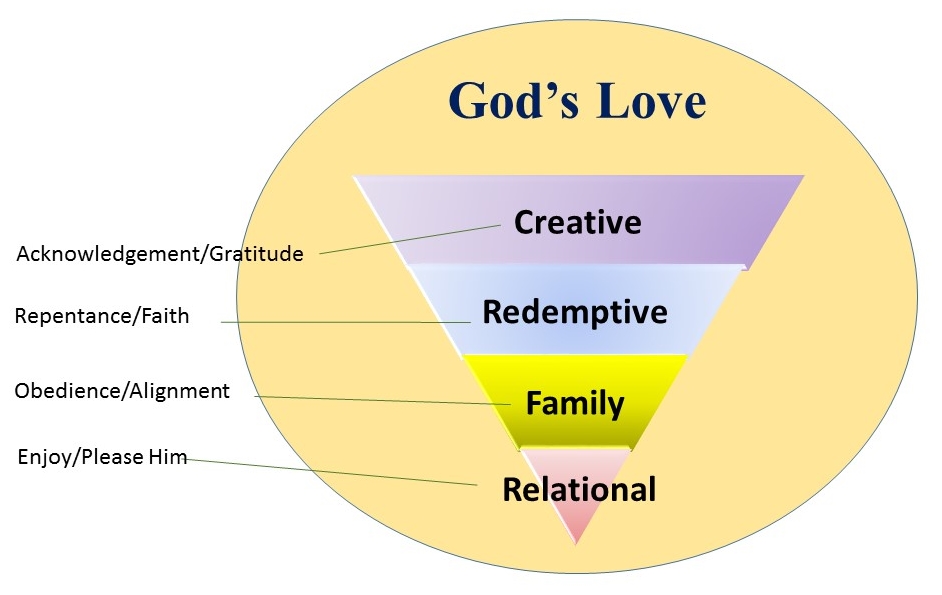
            Previously I suggested that in order for love to be known and experienced, it must be expressed and responded to.  I have also offered four specific expressions of God’s amazing love that take us deep into His heart.  In this blog I want to suggest that along with the love expressions there is a fitting love response that He desires.  Using a popular metaphor, we need to respond according to His “love language”. 

            A cut diamond refracts light to reveal an array of colors.  In the same way, as the white light of God’s love touches the prism of broken humanity, the hidden colors are revealed.  The primary colors of God’s love could be called:

            • His creative sustaining love
            • His individual redemptive love
            • His covenant family love
            • His relational intimate love

            Each of these expressions of God’s love is an outgrowth of His grace and is, therefore, given without human merit.  However, we do not automatically experience them. 

            God offers each expression of love, but experiencing that love depends on our response implying that

            • God’s love is always unmerited but not always unconditional
            • We are as close to Christ as we choose to be

            The broadest expression is God’s creative sustaining love.  It is given without merit or condition and is evidenced by all that He has created.  Even those who reject God are recipients of His love demonstrated in our amazingly complex spacecraft:  earth.  The apostle Paul identified the proper response to this creative sustaining love as reverence and gratitude (Romans 1).

            A deeper relationship is found through His individual redemptive love where He releases people from captivity to the domain of darkness into the kingdom of light (Col. 1:13-14).  This love is expressed in the familiar first part of John 3:16.  But in order to experience this love, the appropriate response must be repentance and belief in the Gospel (John 3:16b; Mark 1:15).        

            The next expression of God’s love, His covenant family love, is found in our new identity as  children of God (John 1:12; 1 John 3:1-3).  God expresses His family love through gifts including justification, adoption, citizenship, and the indwelling of the Holy Spirit.  The expected response to this expression of love is a life of obedience and alignment with God’s will (John 14:21). 

            The relational intimate love of God adds another even deeper, more personal, and dynamic level of relationship.  This expression of love is the continued revelation of Himself as we walk in Him (Col 2:6).  This is the love expression that Jesus talks about with His disciples in the upper room discourse:

            If you keep My commandments, you will abide in My love; just as I have kept My Father’s commandments and abide in His love…You are My friends if you do what I command you.  No longer do I call you slaves, for the slave does not know what his master is doing; but I have called you friends, for all things that I have heard from My Father I have made known to you (John 15:10-15 ).

            This “friendship” love that was now part of the disciples’ experience, wasn’t automatic.  It came as a result of their continued alignment with Jesus and His kingdom, resulting in greater exposure to the heart and mind of God in Christ.

            I think this deeply personal and relational love expression is what Jesus was asking for in John 17:

            … I have made Your name known to them, and will make it known, so that the love with which You loved Me may be in them, and I in them (John 17:26).

            The offer of this expression of His love is humbling, even overwhelming to me, yet it is amazingly what God desires us to discover.  It is what our soul looks for but in all the wrong places.

            The natural response to this intimate love of God is to simply enjoy His person and presence.  It was what Mary was commended for in Luke 10:  “Mary, who sat before the Master, hanging on every word he said” (MSG).  It is a response of affection that desires God even without His blessings.  Habakkuk expressed it this way: 

            The white light of God’s love with its various colors is what we are called to experience and reflect on the resurrection side of the cross.

            Though the fig tree should not blossom And there be no fruit on the vines, Though the yield of the olive should fail And the fields produce no food, Though the flock should be cut off from the fold And there be no cattle in the stalls, yet I will exult in the LORD, I will rejoice in the God of my salvation (Hab. 3:17-18).

            Experiencing the increasing depth of God’s iridescent love reminds me of the Russian Matryoshka dolls where each time an outer doll is removed, another doll is revealed deeper within.  Each time we experience one expression of His love, the opportunity for an even deeper one is presented. 

            Understanding God’s iridescent love is the privilege of discipleship.  It demonstrates the value and delight He finds in each of us as He looks through our brokenness to the person we are in Christ: the person He created…redeemed… adopted… and calls by name.  This amazing and wonderfully complex love of God invites us into a timeless relational journey called eternal life (John 17:3). 

            Questions for reflection:

            1.  Each love expression has a unique response.  What happens when we get them mix up?

            2.  How do these love expressions complement and support each other?

            3.  How is spiritual maturity related to these love expressions?

            .