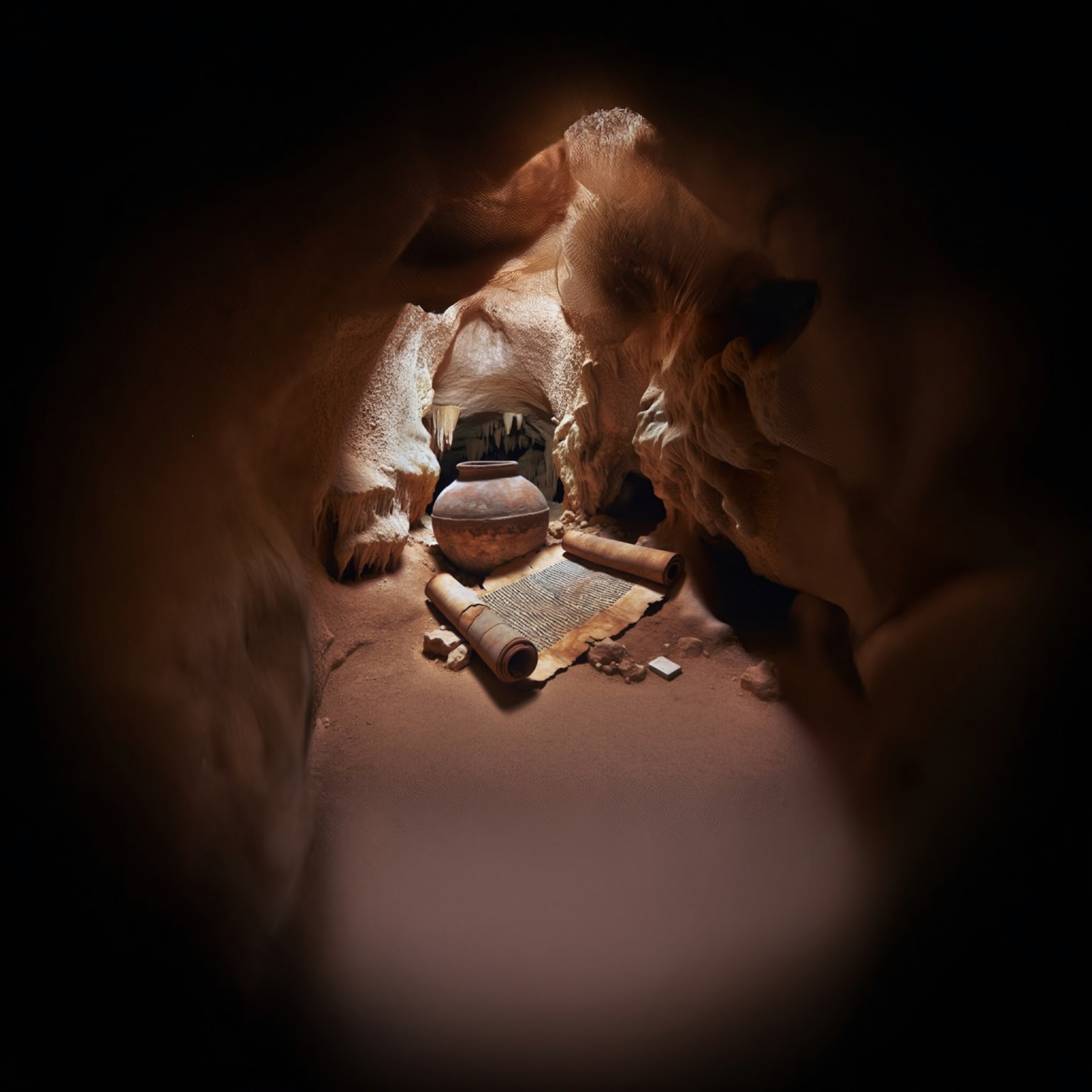
It was 1947 in the barren Judean hills near the Dead Sea. Two Bedouin shepherds roamed the rocky slopes, searching for goats that had strayed from the herd. The sun beat down. The air was still. Then one of them spotted a narrow opening in the cliffs. Perhaps the animals had taken shelter there.
Bending down, he tossed a rock inside. Instead of a bleating goat, the air was filled with the sharp crack of breaking pottery. The sound was strange—almost eerie—and it would one day be heard around the world.
Inside the dark cave stood several clay jars. Some lay shattered; others remained sealed. Expecting treasure, the shepherds opened them, only to find old parchment scrolls wrapped in linen, their surfaces blackened with age. Disappointed, they sold the scrolls to an antiquities dealer. Eventually, the manuscripts reached a monastery in Jerusalem, where they were handled casually—until someone recognized their true value.
These were the oldest surviving manuscripts of the Jewish Scriptures, dating back to around 200 BC. Over the next decade, more caves would be discovered, yielding fragments from over 900 manuscripts.
By the early 1990s, the Israel Antiquities Authority established a dedicated conservation lab to preserve these fragile treasures. What had once been dismissed as worthless was revealed to be one of the most valuable archaeological finds in history—worthy of reverence and protection.
The gospel is like that. It is a priceless treasure entrusted to each generation—not only to proclaim, but also to guard, preserve, and pass on intact to those who come after us.
Paul: Preacher and Protector
The Apostle Paul was not only a herald of the gospel but also its guardian. He knew the message could be distorted—by additions, subtractions, or outright alterations—and warned Timothy to protect it:
Guard, through the Holy Spirit who dwells in us, the treasure which has been entrusted to you.
— 2 Timothy 1:14 (see also 1 Timothy 6:20)
In this article, we’ll examine the first danger Paul identified: additions to the gospel.
- Guarding Against Additions
After their first missionary journey, Paul and Barnabas returned to Antioch, where the gospel had taken root among Jews and Gentiles alike. But trouble soon arrived in the form of certain Jewish believers from Jerusalem, who insisted that circumcision was necessary for salvation.
Adding circumcision meant adding works to faith and merit to Christ’s righteousness. In Luke’s understated words, Paul and Barnabas had “no small dissension” with them (Acts 15:2). In modern terms—Paul was livid.
To settle the matter, the Antioch church sent a delegation, including Paul and Barnabas, to Jerusalem to consult the apostles and elders. The issue was clear: if the gospel was to cross cultural boundaries, it had to be free from the weight of religious tradition and cultural baggage.
When the leaders gathered, Paul testified how God had worked among the Gentiles without requiring circumcision. Peter concluded:
“But we believe that we are saved through the grace of the Lord Jesus, in the same way as they also are.” — Acts 15:11
Verdict: circumcision is not essential to the gospel. Leave it out.
Armed with a letter from Jerusalem, the delegation returned to Antioch with clarity. But the danger wasn’t gone. In Galatia, Paul faced the same problem—Jewish believers trying to elevate law-keeping into a mark of “higher” spirituality. Paul’s response was sharp:
I am amazed that you are so quickly deserting Him who called you by the grace of Christ, for a different gospel; which is really not another… (Galatians 1:6–7)
Peter’s error in separating from Gentile believers gave Paul the opportunity to reaffirm the heart of the gospel.
Modern Additions
We face the same temptation today—to “add a little something” to the simple call of the gospel. Over time, small cultural additions can become entrenched traditions that subtly alter the message.
One example is the phrase, “Invite Jesus into your heart” as the response to the gospel. It’s well-meaning, but it’s never found in Scripture. Likely drawn from a misreading of Revelation 3:20, it was popularized through Holman Hunt’s 1853 painting The Light of the World. This image of Jesus knocking on a door became a standard evangelistic illustration in sermons, hospitals, and homes.
The shift, though subtle, is significant: from God’s invitation for us to enter His kingdom, to us inviting Him into our personal kingdom. It feeds the very self-focus the gospel came to transform.
Guard the Treasure
Just as the Dead Sea Scrolls had to be handled with care to preserve their original form, so the gospel must be safeguarded against human alterations. Additions—no matter how small—risk obscuring the glory of grace with the dust of our own traditions.
In every generation, the call is the same: proclaim the gospel faithfully, guard it diligently, and pass it on unaltered.
For Discussion
- Why was Paul so passionate about guarding the gospel against additions like circumcision?
- How does Paul’s confrontation with Peter in Galatians highlight the seriousness of preserving the gospel’s purity?
- Can you think of modern examples where well-meaning traditions or phrases have subtly altered the gospel message?
- What is the difference between inviting Jesus into our lives and responding to His invitation to enter His kingdom?
- What additions or distortions to the gospel have you encountered in your own Christian experience?