On May 8, 1945, President Truman sat before a microphone and told the American people that World War II in Europe had ended. German forces had surrendered.
Now, picture yourself at your desk that day. One by one, friends and coworkers stop by and say:
- “My son is coming home from France!”
- “No more gas rationing—I can finally drive anywhere I want!”
- “The government is paying for my husband’s education!”
- “The war in Europe is over. Germany surrendered.”
All of those are good news. But only one announcement carried national significance. Only one was the source from which all the other celebrations flowed: Germany had surrendered. The war was over.
That moment forces a question for us today: When we say “gospel,” what exactly is the content of our good news? Are we confident that the message we preach is the same life-giving gospel proclaimed in the first century?
A High-Altitude Look at the Gospel in Scripture
Old Testament
The Hebrew word for “gospel” is bisar. It simply meant “news,” good or bad, depending on the situation.
When David chose Solomon as his successor, the whole realm celebrated—except for Adonijah, who had already tried to make himself king (1 Kings 1:41–42). For him, that was bad bisar.
But Isaiah lifts our eyes to a cosmic announcement:
“How beautiful on the mountains are the feet of the messenger who brings good news… who says to Zion, ‘Your God reigns!’” (Isa. 52:7)
This wasn’t just private encouragement. It was kingdom news.
New Testament
Paul echoes Isaiah when he writes:
“Everyone who calls on the name of the Lord will be saved… How can they believe in him if they have never heard about him?” (Rom. 10:13–15)
And Jesus begins His ministry with the same kind of proclamation:
“The time promised by God has come at last! The Kingdom of God is near! Repent and believe the Good News!” (Mark 1:15)
The gospel isn’t a vague spiritual uplift. It’s a royal announcement: God’s kingdom has arrived in Jesus.
What Scripture Actually Says
In the New Testament, the phrase “gospel of ___” shows up in some very specific ways:
- Gospel of God – 10 times
- Gospel of Jesus Christ – 12 times
- Gospel of the Kingdom – 4 times
- Gospel of grace, peace, salvation – once each
What’s missing? Phrases like “gospel of forgiveness,” “gospel of justification,” or “gospel of eternal life.” Those are effects of the gospel—not the gospel itself.
Too often today, we shrink the gospel down to its benefits. Biblically, the gospel is first about who Jesus is and what He has done—and then about what flows out from that.
The Hub and the Spokes
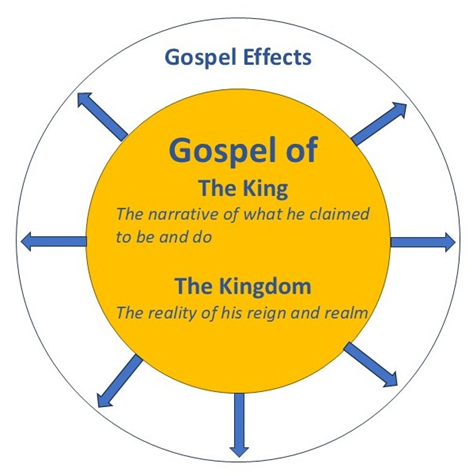
Think of the gospel like a hub with spokes.
At the center—the hub—is Jesus Christ, His identity, and His kingdom.
From that hub flow the spokes: forgiveness, peace, transformation, eternal life. All of these are real, but they are benefits, not the core.
Oswald Chambers warned:
“If we simply preach the effects of redemption in the human life instead of the revealed, divine truth regarding Jesus Himself, the result is not new birth… only a refined religious lifestyle.”
A gospel centered on gifts rather than the Giver lacks the power to transform.
The Gospel Is a Story
Each of the four Gospels proclaims not just ideas, but a person and a story:
- Matthew: Jesus, the King of the Jews
- Mark: the suffering servant-king
- Luke: the Savior of all nations
- John: the divine Son bringing eternal life
Mark opens with it plainly:
“This is the Good News about Jesus the Messiah, the Son of God.” (Mark 1:1)
Paul ends the book of Acts doing the same:
“Proclaiming the kingdom of God and teaching about the Lord Jesus Christ with all boldness and without hindrance.” (Acts 28:31)
For Paul, the gospel always had a two-fold core: Jesus and the Kingdom.
RC Sproul put it bluntly:
“The gospel is Jesus Christ—who He is and what He has done. If we are not preaching that, we are not preaching the gospel.”
Is Our Gospel Too Shallow?
If our message starts and ends with “what Jesus can do for you,” we may inspire people—but we won’t transform them. A gospel stripped of Christ’s story and kingship is a shallow gospel. And a shallow gospel eventually produces a hollow faith.
The gospel of Jesus is the good news. Everything else is commentary.
Coming Next…
In the next post: The Seven Defining Moments of the Gospel Narrative—a journey through the turning points that shape the gospel’s story and power.
For Discussion
For Discussion
- In the WWII story, why was the announcement of Germany’s surrender the “big news,” while the other stories were only secondary?
- How does this illustration help us think about the difference between the gospel itself and the benefits of the gospel?
- Why do you think phrases like “gospel of forgiveness” or “gospel of eternal life” are absent, even though those are real blessings?
- Which “spoke” (forgiveness, peace, eternal life, transformation, etc.) do you think Christians today emphasize the most? Is there a danger in making that the center?
- Do you think our churches tend to present the gospel as “what Jesus can do for you” more than “who Jesus is and what He has done”? Why?